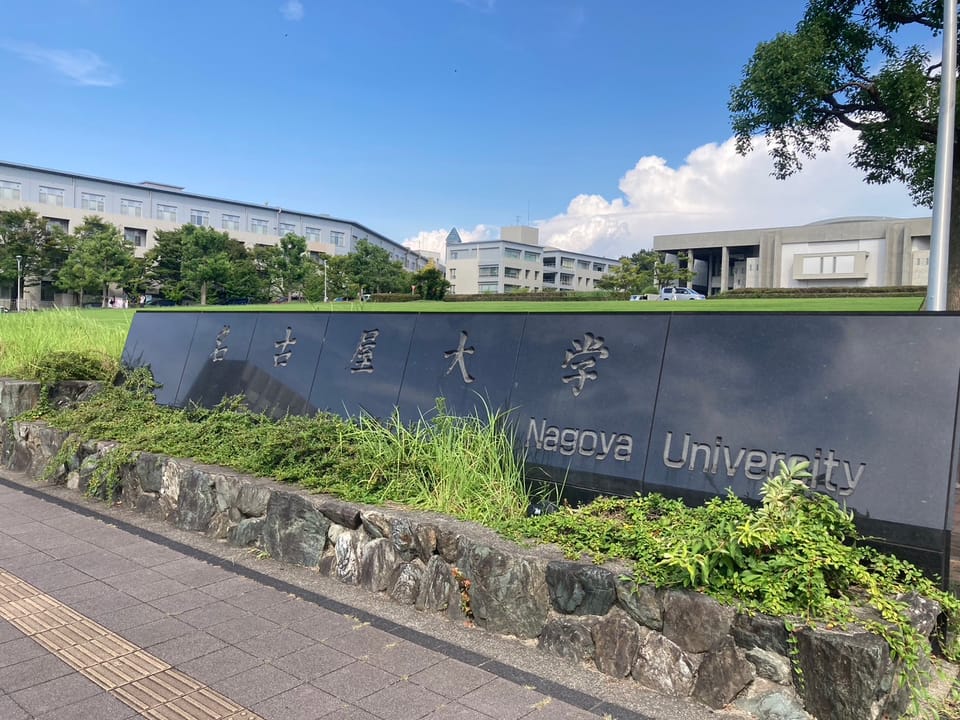
Nagoya University Summer Entrance
Overview
A whole year has passed, and yet I hadn’t written anything. As time went on, I often thought about putting my exam prep experience into words, but those thoughts would always be suppressed in a fleeting moment, again and again, gradually leaving me with a sense of unease.
After starting work, I began to feel that perhaps I owed it to my past self to give some closure — and so, on one quiet night, I finally picked up the pen.
I hope this article can offer some guidance and inspiration to those who are considering studying in Japan for graduate school but don’t know where to start — even if just as a small light along the path ahead.
My Original Post
Background
- Undergraduate: National Yunlin University of Science and Technology, Department of Information Management
- Extracurricular: Piano Club Officer
- Exchange Program: Osaka Institute of Technology iPBL Program
- Work Experience: 1.75 years
- Academic & Language Scores:
- GPA: 2.47 / 4
- JLPT: N1
- TOEIC: 910 / 990
- TOEFL: 90 / 120
Given my background, the only realistic option was taking the general entrance exam. Paths like G30 or SGU were completely out of the question.
I didn’t study during university — I spent most of my time gaming or participating in clubs. To be honest, even with a perfect GPA of 4.0/4.0, the chances of getting into a top university through the G30 program would still be extremely slim. G30 applicants are competing with top-tier students from all over the world. You'd realistically need to be from a top-4 university (like the "C9" in China or equivalent elsewhere) to stand a decent chance. At least among the seniors I know who went through this route, I’ve yet to see an exception.
Timeline
- Jun 2021 – Feb 2023: Software Engineer in Taichung
- Feb 2023: TOEFL Exam
- Feb – Apr 2023: Reviewed Linear Algebra, Calculus, Probability & Statistics, C Programming, Operating Systems, and Control Theory
- May 2023: Interview with Nagoya University Professor
- May 2023: TOEIC Exam
- Jun 2023: Prepared application materials and submitted to various universities
- Jun – Jul 2023: Focused on past exam questions
- Aug 2–3, 2023: Nagoya University Written and Oral Exams
- Aug 7–8, 2023: Kyoto University Written and Oral Exams
Application Choices and Subjects
Initially, I aimed solely for Kyoto University but decided to apply to Nagoya University after securing a preliminary acceptance from a professor.
Nagoya University – Department of Complex Systems Science
Applicants can choose any three subjects from over 20 options. I selected:
- Math I: Linear Algebra
- Information I: C Programming
- Engineering I: Control Engineering
◎ Written Exam – August 2, 2023
Based on my own experience with the entrance exam:
I personally chose Mathematics 1 (Linear Algebra), Information 1 (C Programming), and Engineering 1 (Control Engineering) as my three exam subjects. These subjects basically aligned with the ones I had already been preparing for Kyoto University, so I didn’t do any additional preparation for other subjects.
That said, under the Complex Systems Science exam category, the subject "Fundamentals of Informatics" is divided into Information 1 (required), Information 2, and Information 3 (recommended). So essentially, you can choose these three subjects for the exam without needing to prepare for other fields at all.
Mathematics Subject 1 (数一):
This was entirely focused on linear algebra. This year’s questions mainly revolved around the Jordan form, and even the extended problems were just elaborations on that. Once you identify the eigenvalues and compute them, the problems aren’t too difficult.
That said, in previous years there were proof-based and geometry questions too, so don’t let your guard down. It’s essential to review linear algebra thoroughly — not just for the exam, but because it’s a core subject across many fields. Whether it’s machine learning, deep learning, reinforcement learning, or even programming problem solving, linear algebra is indispensable. Not to mention quantum computing, which requires even deeper matrix knowledge.
Engineering Subject A (工一):
This is essentially about control theory. To summarize in one word: Laplace.
If you’re good at Laplace transforms, you’re already halfway prepared. If you can’t even take the Laplace transform of a function, there’s no point trying to solve the problem. In my experience, Nagoya University’s control theory problems aren’t so much about the Laplace transform itself, but about your understanding of different physical systems. Since I come from a vocational high school background, I struggled a lot with questions on mechanics and electricity.
In contrast, Kyoto University’s control theory questions are much simpler — at least you’re not required to derive the physical systems yourself.
As for the English proficiency score, there’s probably no need to say much—TOEIC is by far the most cost-effective option. A score of 900 will reliably give you a solid 90/100 in the language section. From what I’ve seen and heard from other successful applicants, most had scores in the 800s. The old saying holds true: aim for the highest score you can, because scoring is relative. Even if you feel your English is weak, it’s entirely possible to raise your score through sheer volume of practice questions. If you put in the effort, getting a 700 shouldn’t be a problem.
However, be careful not to spend too much time on the language exam. Scores in your specialized subjects are far more important. The difference between an 800 and a 950 on TOEIC is smaller than the difference made by just one question on a subject exam. So it’s not worth over-investing your time just to gain a few extra points there.
Most people don’t apply to just one or two universities—three or more is common. In my case, due to several reasons, I only applied to one, but if I had a second chance, I would apply to more schools, such as Osaka University.
One thing to note: my prospective academic advisor asked me in advance if I had an N1 certificate. After asking around, every single international student in the lab had one. Due to visa-related reasons, many had stayed at Japanese language schools for almost or more than a year. So it’s important to check directly with the professor about language requirements ahead of time.
That said, if we’re strictly talking about the official application requirements, Japanese language ability is not included in the scoring criteria.
◎ Interview – August 3, 2023
Basically, the interview was just a formality, and scores were almost always given full marks.
When I entered the exam room, there were three professors plus a consultant who was also an international student. The main interviewer happened to be my prospective advisor. What was kind of funny was that the consultant immediately asked me which five professors I had listed as my preferred choices. Honestly, I didn’t understand the purpose of this question at all. At that moment, I only remembered that I had chosen my advisor, and completely forgot the rest. On top of that, my Japanese listening skills were completely wrecked by their rapid speech, so I had to keep saying, “すみません、ちょっと聞き取れませんでした、もう一度お願いします。” (“Sorry, I didn’t quite catch that, could you say it again?”) But even then, I still couldn’t understand and felt like a clown.
I guess the reason might have been to check if my scores didn’t meet the standard and possibly consider shifting me to another preferred choice. But it’s quite mysterious, because the other four preferences were just filled in randomly. Without any prior contact or meeting with those professors, it’s basically impossible to have an interview with them beforehand.
After that, they asked about my university research work. I talked about my undergraduate project and briefly mentioned my previous job experience. Finally, they asked about my plans for future research. But I didn’t have much to say since my undergraduate project was mostly carried by my friend Johnny, so I didn’t really say anything substantial here.
Kyoto University – Department of Systems Science
Applicants must take two basic subjects (Linear Algebra and Calculus) and choose two specialized subjects. I selected:
- Complex Function Theory
- Probability & Statistics
- Signal Processing
- Control Engineering
Exam Insights:
- Basic Subjects: Challenging, especially Calculus.
- Specialized Subjects:
- Probability & Statistics: Included Maximum Likelihood Estimation and Copula Density Functions; demanding for those without a strong foundation.
- Control Engineering: Covered transfer functions and feedback systems; manageable with a good understanding of classical control theory.
Reflection:
Kyoto University's exams were notably more difficult. In hindsight, selecting subjects like Control Engineering and Signal Processing might have been more strategic.
Final Thoughts
On the path of preparing for entrance exams, the idea of "survivorship bias" left an unexpectedly deep mark on my heart.
I started thinking about studying in Japan during the second half of my junior year in college, but I lacked a clear goal and the persistence to follow through. I even failed an exchange program application once. After graduating, finishing my military service, and working for two years, I realized that my life was gradually drifting away from my ideals. My days began to feel dull and meaningless, and I still couldn’t fully understand the fundamental reason behind my decision to pursue this path.
At the same time, I came to terms with the fact that I am neither particularly good at studying nor someone who enjoys it. There are so many brilliant people in the world, and I already have to give my all just to keep up with my own life. Strangely enough, though, I’ve found it hard to give my all to pursue any one thing. That, in fact, was the reason I failed to get into Kyoto University. During the six months of intense preparation, there were many days when I could only study for five or six hours — the rest of the time, I’d end up flipping through manga until I fell asleep. Sometimes I’d see others in the exam prep group discussing past Kyoto University questions and realize just how hopeless I seemed in comparison.
To be honest, I still sometimes feel bitter about not getting into Kyoto University. But sharing that with friends doesn’t really bring relief, since we’re all walking different paths. All I can do is try to forget, and fool myself with the idea that “at least I gave it my best.” I actually had another chance to try again in the winter, but it was me who chose to give up. Still, life must move forward.
Along the way, I learned a great deal. Compared to my university days, the amount of knowledge I have now is simply incomparable. What’s truly important for me is turning studying into a part of daily life. If I go even a few hours without studying, something feels off — this internal push keeps me moving forward. I do get tired sometimes, but after a while, I get used to the rhythm of switching gears.
Someday, I hope to share more about life, courses, and job hunting in a Japanese graduate school.
May we all, in the future, live lives that feel more true to ourselves.
I know that even if I could do it all over again, it might not turn out any better than it is now. This was already the best decision I could see and think of at the time. “The world is wonderful, but so are you.” — Wantete